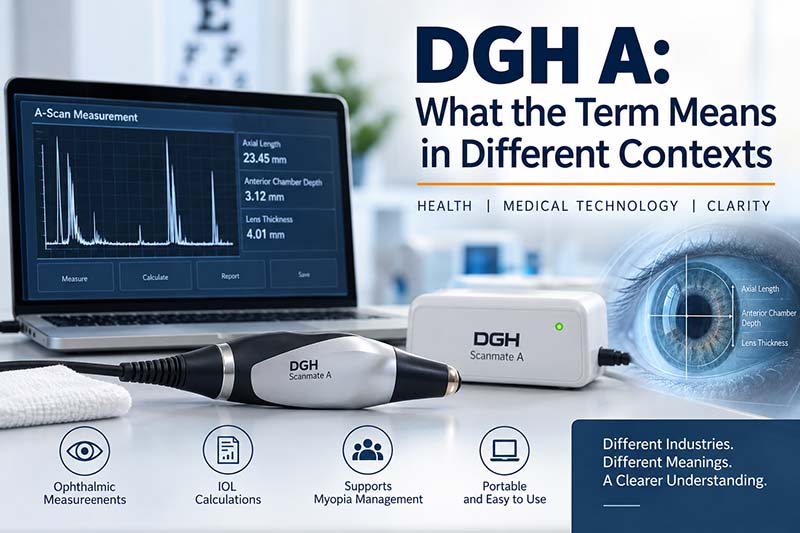
The term DGH A can be confusing when it appears alone in a search, document, product listing, or technical discussion. Without context, the letters do not provide enough information to establish one universal meaning. In medical technology, however, one important and verifiable association is with DGH Technology’s Scanmate A, formally identified as the DGH 6000, an ophthalmic ultrasonic A-scan system. Understanding the surrounding context is therefore essential before interpreting the term or acting on information attached to it.
Why the Term Can Be Difficult to Interpret
Short combinations of letters are common in healthcare, engineering, government, business, and technology. The same abbreviation may refer to unrelated organizations, products, procedures, or internal classifications.
That makes context more important than the abbreviation itself.
For example, a reader who encounters “DGH” in a hospital document may interpret it differently from an eye-care professional reading the same letters in an equipment catalogue. Adding the letter “A” does not automatically create a standardized medical abbreviation.
This distinction matters because search results can sometimes combine legitimate terminology with interpretations that have little authoritative support. A responsible approach is to look at where the term appears, what subject is being discussed, and whether an official source confirms the intended meaning.
In ophthalmic equipment, there is a clear connection: DGH Technology manufactures the Scanmate A, also known by its model designation DGH 6000. The U.S. National Library of Medicine’s AccessGUDID database also identifies the Scanmate A as a portable ultrasonic A-scan manufactured by DGH Technology.
DGH A in Ophthalmic Medical Technology
The strongest documented medical-technology interpretation involves the DGH 6000 Scanmate A.
DGH Technology describes the system as an ultra-portable A-scan designed for ophthalmic measurements. It connects to a compatible Windows computer and uses ultrasound technology to obtain measurements of structures within the eye.
The U.S. Food and Drug Administration documentation for the device provides an even more precise description of its intended use. According to its FDA indications for use, the DGH 6000 is intended to measure axial length, anterior chamber depth, and lens thickness. It can also calculate the optical power of an intraocular lens intended for implantation during cataract surgery. The FDA documentation specifies that the device is for use by qualified medical professionals.
Readers looking for primary product information can consult the official DGH Technology Scanmate A product page.
This documented product association is considerably more reliable than trying to expand the letters into an unsupported phrase.
What Is an A-Scan?
An A-scan is a form of ultrasound used in ophthalmology to obtain measurements along an axis of the eye. Unlike an imaging technique intended mainly to create a recognizable two-dimensional picture, an A-scan records information that can be used for ocular biometry.
One important measurement is axial length—the distance along the eye’s visual axis. Accurate biometric measurements are particularly relevant when clinicians calculate the power of an intraocular lens, or IOL, before cataract surgery.
The DGH 6000 uses ultrasonic pulse technology for these measurements. According to DGH Technology, its system supports measurements through either direct corneal contact or an immersion technique.
This helps explain why the “A” in Scanmate A matters. It identifies the A-scan modality rather than functioning as a general-purpose suffix with the same meaning wherever “DGH” appears.
How the Scanmate A Works
The Scanmate A combines an ultrasound probe with computer-based software. The hardware connects to a compatible computer through USB, while the software handles measurements, calculations, patient records, and reports.
DGH lists two measurement approaches for the system.
Contact Measurement
In contact mode, the probe is applied directly to the cornea to obtain measurements. Because pressure against the cornea can affect measurements, the system includes a compression-detection feature intended to help users recognize waveforms that indicate corneal compression.
The device also provides audible feedback related to probe alignment. These tools are designed to assist qualified users in obtaining appropriate measurements rather than replacing clinical technique or professional judgment.
Immersion Measurement
The system can also operate in immersion mode. With this technique, the probe does not measure by pressing directly against the cornea. Instead, ultrasound pulses travel through a water medium before entering the eye.
DGH states that its immersion approach avoids the corneal compression that can occur with direct probe contact. The manufacturer includes a Prager Shell immersion accessory with the system.
The appropriate method depends on clinical circumstances, professional technique, and applicable instructions for use.
Measurements and IOL Calculations
The medical significance of the DGH A association becomes clearer when considering the measurements supported by the Scanmate system.
The manufacturer lists an axial-length measurement range of 15.00 to 40.00 mm. It also lists measurement ranges for anterior chamber depth and lens thickness, with a stated resolution of 0.01 mm.
The accompanying software supports multiple IOL calculation formulas. DGH lists formulas including SRK/T, Holladay 1, Hoffer Q, and Haigis, as well as several options for post-refractive cases.
These calculations have a specific clinical purpose. The FDA documentation states that the device is intended to calculate the optical power of an IOL that will be implanted during cataract surgery.
That does not mean a patient should use measurements or software outputs to make treatment decisions independently. Device results form part of a professional clinical process, and the FDA documentation explicitly calls for clinical consideration and judgment.
Role in Myopia Management
DGH Technology also presents the Scanmate A as a tool that can support myopia-management programs by tracking axial-length measurements over time.
The software can generate an Axial Length Progression Report, allowing measurements recorded at different times to be charted.
This is a useful example of how ocular biometry can extend beyond calculations associated with cataract procedures. Measuring changes in axial length can provide clinicians with objective information about eye growth.
However, measurement data should not be interpreted in isolation as a diagnosis or individualized treatment recommendation. Eye-care professionals must consider the broader clinical picture.
DGH A Does Not Have One Universal Expansion
One of the biggest mistakes when researching an ambiguous keyword is assuming that every occurrence must have the same definition.
“DGH,” for example, can appear independently in institutional or healthcare terminology. But that does not establish “DGH A” as a universal abbreviation with a single official expansion.
For that reason, readers should be cautious with websites that present a convenient full form without identifying an authoritative source. A plausible interpretation is not necessarily an officially recognized one.
When the context involves ophthalmic ultrasound equipment, the DGH Technology product family provides a documented interpretation. The manufacturer lists Scanmate A alongside other ophthalmic products such as Scanmate B, Scanmate Flex, Pachmate 2, and Pachette 4.
Outside that context, the term should be interpreted according to its original source rather than automatically assigned the medical-device meaning.
How to Identify the Correct Meaning
A few checks can prevent confusion when encountering an unfamiliar abbreviation:
- Check the surrounding words. References to ophthalmology, axial length, ultrasound, IOL calculations, cataract procedures, or Scanmate strongly point toward the ophthalmic-device context.
- Look for a model number. “DGH 6000” is a specific identifier associated with the Scanmate A.
- Identify the source. Manufacturer documentation, FDA records, device databases, hospitals, and professional organizations provide stronger evidence than anonymous acronym pages.
- Avoid assuming a full form. If an abbreviation is not officially defined in the source, do not invent an expansion based on what seems plausible.
- Consider the industry. The same letters may mean completely different things in healthcare, technology, government, education, or business.
These checks are particularly important with medical terminology, where an incorrect interpretation can create more than simple semantic confusion.
Why Authoritative Sources Matter
Medical devices are a good example of why source quality matters.
A manufacturer can provide product specifications, operating requirements, supported features, and manuals. Regulatory documentation can establish intended use and regulatory information. Government-maintained device databases can help verify the manufacturer, model, and general device description.
Using these sources together creates a clearer picture than relying on a single secondary article.
For the Scanmate A, DGH Technology’s current product information, its resource library, FDA documentation, and the National Library of Medicine’s AccessGUDID database consistently identify the DGH 6000 as an ophthalmic ultrasonic A-scan.
This consistency is important because it separates a documented medical-device association from speculative acronym interpretations.
Frequently Asked Questions
What does DGH A mean?
There is no evidence that the phrase has one universal expansion across every industry or document. In ophthalmic medical technology, it is strongly associated with DGH Technology’s Scanmate A, model DGH 6000. Other uses should be interpreted according to their specific source and context.
What is the DGH 6000 Scanmate A?
It is a portable ultrasonic ophthalmic A-scan manufactured by DGH Technology. FDA documentation states that it is intended to measure axial length, anterior chamber depth, and lens thickness of the human eye and to calculate intraocular lens power for cataract surgery.
Is the Scanmate A used for cataract surgery planning?
It can provide ocular measurements and IOL calculations relevant to cataract surgery planning. The device itself does not perform cataract surgery. Its FDA indications specify measurement and IOL-power-calculation functions and state that it is intended for qualified medical professionals.
Can the device take measurements without direct corneal contact?
The Scanmate A supports both contact and immersion measurement modes. In immersion mode, ultrasound travels through a water medium, avoiding direct probe compression of the cornea during measurement.
Is every use of the abbreviation related to ophthalmology?
No. Short abbreviations can have different meanings across organizations and industries. The ophthalmic interpretation is appropriate when the context points to DGH Technology, Scanmate A, the DGH 6000, A-scan ultrasonography, ocular biometry, or related eye-care terminology.
Also Read: Boundless Learning Layoffs
Conclusion
DGH A should not be treated as a universal abbreviation with one assumed definition. Its meaning depends on where and how the term appears, although there is a well-documented medical-technology connection to DGH Technology’s Scanmate A, or DGH 6000, an ultrasonic ophthalmic A-scan used by qualified professionals for ocular measurements and IOL calculations. Checking the original context and relying on manufacturer and regulatory sources is the safest way to interpret an ambiguous technical term accurately.